
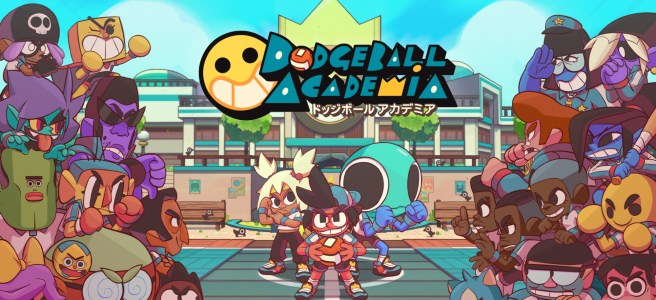
What do you get when you take a real-life game like dodgeball and transform it into a Saturday morning cartoon akin to something like Beyblade? Well, the answer to that is Dodgeball Academia. On paper, it sounds like I should love it. Well spoilers for the rest of this review, I didn’t love all of it. Some elements were awesome, and I will be sure to focus on those, but the missteps were too great in my opinion landing a critical blow to the nose of this otherwise excellent RPG.
Just keep rollin’
The first thing which jumps out when you boot up Dodgeball Academia is the bright colour palette, I absolutely love the vibrant blues and yellows laced throughout the entire game. Even the menus are illuminated with hues which harken back to the days in the 90s when “extreme” was spelt with just two Es. There isn’t anything graphically to sniff at here, it all looks really nice and the bones of the Unity engine don’t show through, as can be the games with less effort poured into them.
There is also a nice effect when you see the game in motion, with all characters being 2D and the environment being rendered in 3D, it gives the entire school where this takes place a diorama-like quality.

So visually, I like it, certainly. When it comes to the overall premise though, I LOVE it. I’m always a fan of when worlds are built around a single element, you could argue it makes the overall story telling more simplistic, and you’d be right, but that doesn’t make it any less endearing. I’ll explain; in Pokemon, everything, and I mean everything revolves around these mostly cute critters which can be used for collecting purposes, or more horrifyingly, war and industry. The same is true of Medabots, Beyblade, Yu-Gi-Oh, everything in these worlds revolves around the single element that makes their world different from our own. Dodgeball Academia does this with something as grounded as dodgeball, and it rules.
A true underdog story
The story starts out with Otto, it is your first day at Dodgeball Academia, and you’re late, obviously. Standard start for any game like this. You arrive at the school and attend the orientation ceremony in the main courtyard, the hub for the game. This allows you to briefly meet the quirky classmates who will form your party or rivals and introduce the mechanics of the battle system when you are challenged by the school bully. From here, you must hone your dodgeball skills, assemble a team, win the annual tournament, saving the school and presumably academic industry in the process. Story-wise, not so original, I get it.
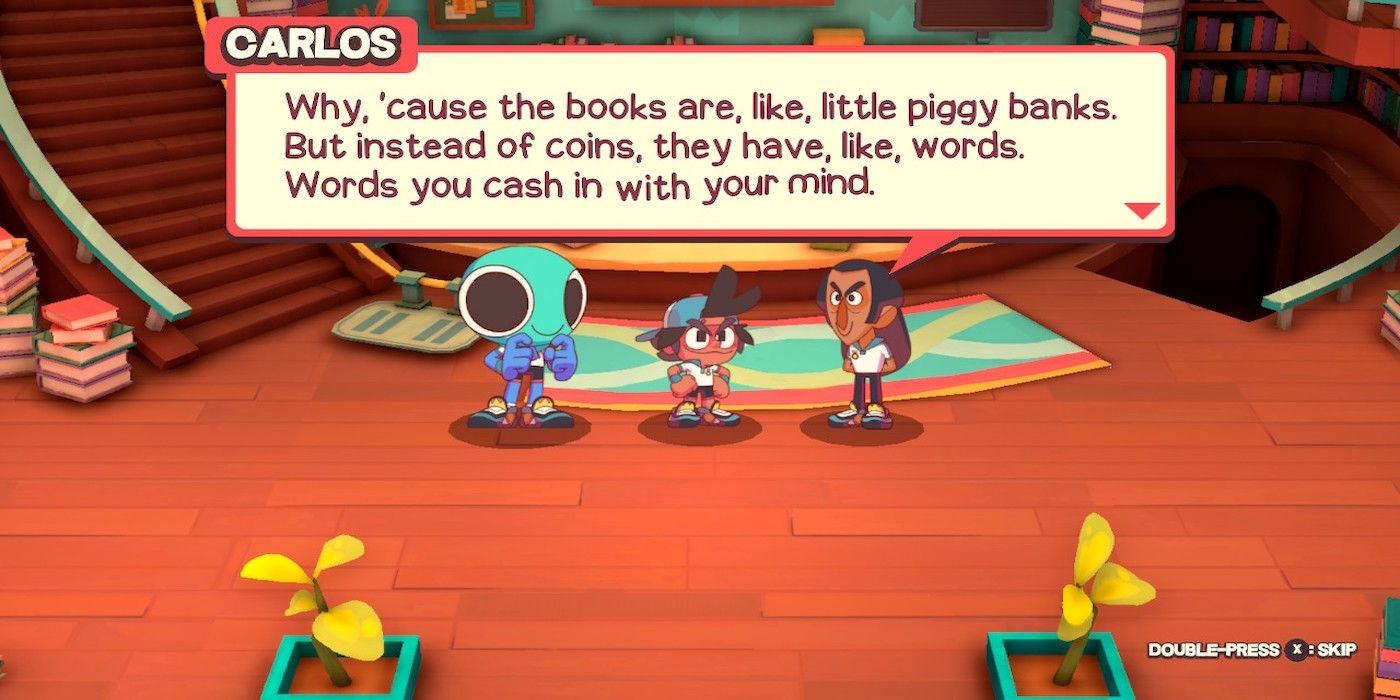
Playing as Otto, the hot-headed, enthusiastic type. Think Naruto, except instead of wanting to be a ninja, just wanting to be really good at dodgeball instead. At the beginning you head around the school grounds, making friends and proclaiming your dream to anyone who would listen in the hopes that they will join your team. Once you have a minimum of three people, the main tournament begins, alongside plenty of lessons and side-stories to keep you busy through the term.
I was far more invested in the main tournament arc, with a clear rivalry, fun story and exciting payoff. The side stories are where I really found myself getting lost and itching for the ‘skip’ button. Some of them are pretty cool, like when you find yourself having to play against a psychic and ultimately coming up with a solution to beat her on the court. Others, however, were just a drag. We will get onto these, I promise.
The 5 Ds
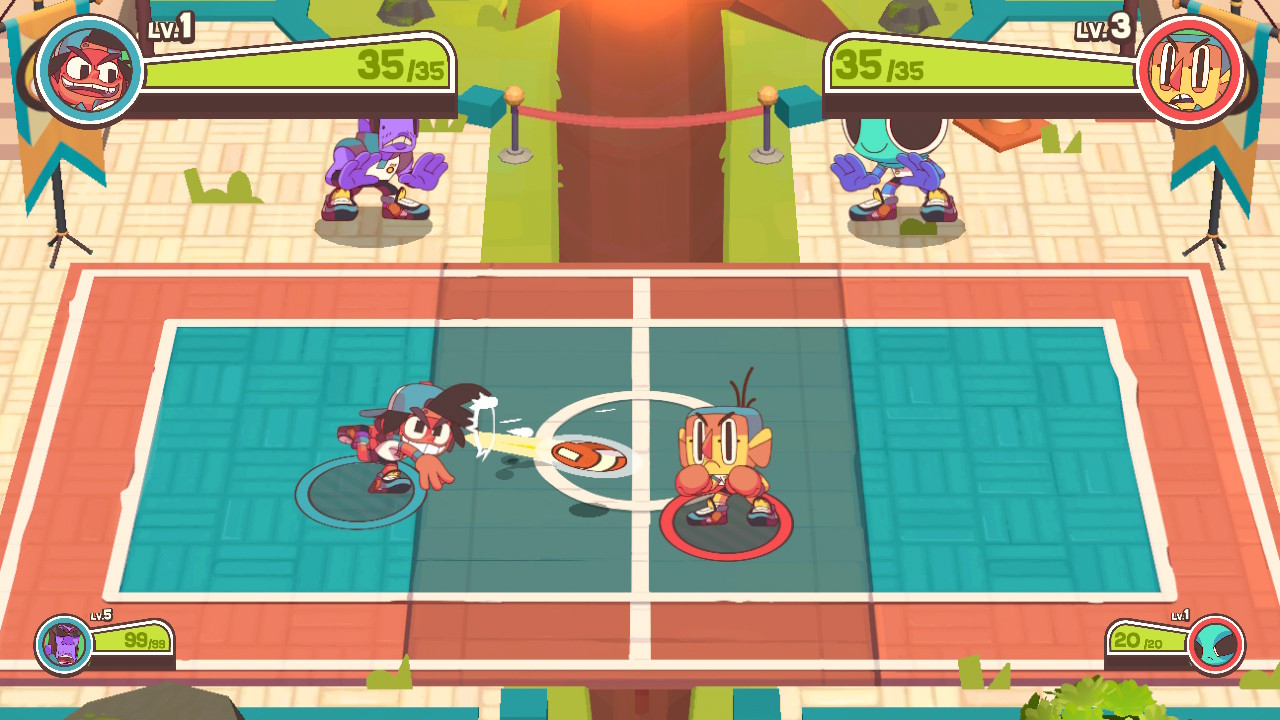
On the gameplay side of things, you might assume that this revolves mostly around playing dodgeball – and you’d be right. The ‘battles’ in Dodgeball Academia are real-time, meaning that you can be rewarded for spatial awareness and expert planning. You can take three party members into each match, which allows for a little bit of strategy as each playable character does have a preferred role. – we’ll get more into the RPG bits in a little while. In order to win a game of dodgeball, you must knock out all opponents by reducing their HP to zero – typical RPG fare.
Thankfully, each character is simple enough to learn with a universal control scheme and rare specific inputs. Every player can perform a combination of the following; a jump/dodge, a catch/parry, a throw and a ‘focus’ whereby a special action will be performed unique to your character. Catching or parrying dodgeballs is where the largest skill gaps will be seen between players. This is rarely required to win certain matches, but can make it much easier and the window to perform this is suitably small to be consistently rewarding as your catch multiple balls in a row. Similarly parrying is satisfying to pull off, just be sure to note that parries can themselves be parried.
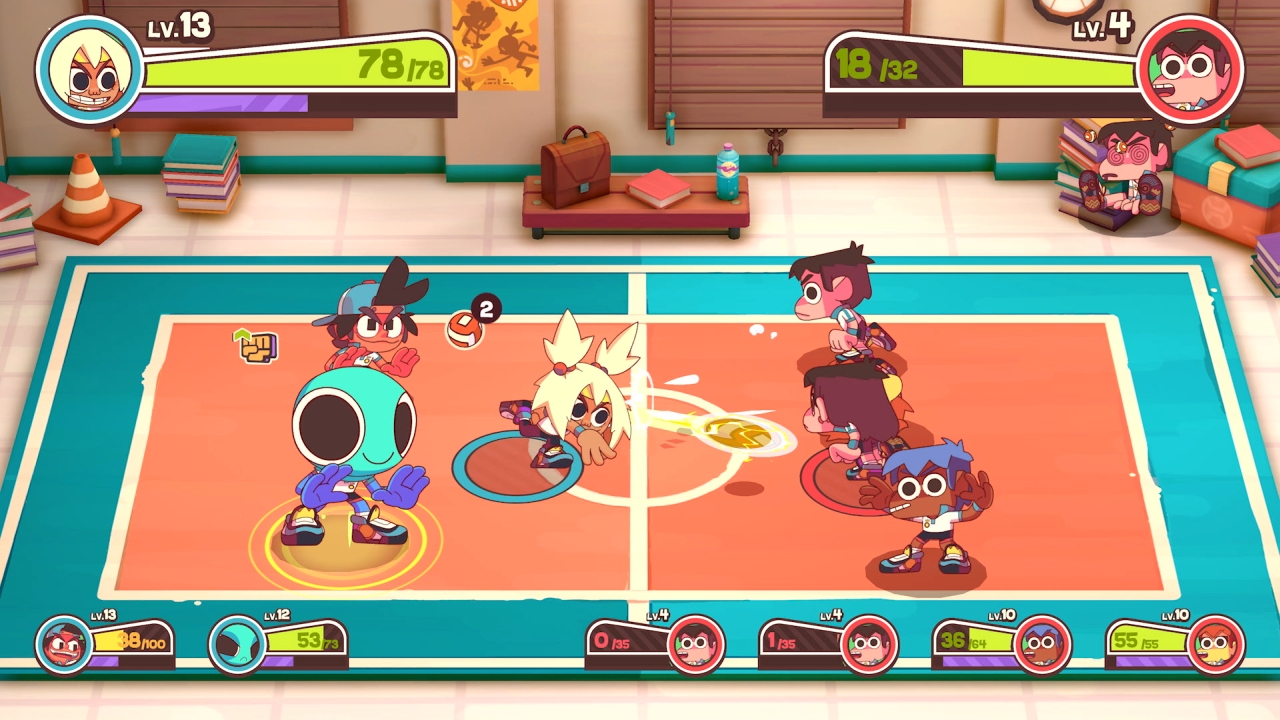
Despite the throwing of each ball being the same button each time, Dodgeball Academia adds further variety by mixing up how players’ throws travel. Otto for example, performs a straight forward throw, whereas Balloony’s throws are weaker, but are able spiral and hit multiple times. Elemental attributes can also be granted based on who is throwing the ball, from RPG cliches like fire and electricity to something a bit more unique like ‘stickiness’, there’s plenty to get your teeth into here.
The last thing I’ll touch on is the special focus actions. These can only be activated when there is at least one ball on the opposing side, meaning there is a nice risk/reward balance to be struck. As you perform this action, charging up like a Dragonball Z warrior, you are unable to move, so it’s important to pick your window carefully. Support players like Balloony can heal your entire party using these, other players might buff themselves, debuff opponents or simply charge their own special meter.

You can also unleash an ultimate ability after performing enough actions, damaging others, catching balls, etc. These impactful techniques vary depending on your player but act as swing moments in some of the lengthy tournament matches. They are appropriately over-the-top, freezing play and flashing with an appropriate anime-like letterbox. Important to note here that everyone has an ultimate ability, and some of them are pretty ludicrous, capable of turning this once jovial sport into a bullet hell nightmare.
It’s fun to dodge, duck, dip, dive and dodge
There is clearly depth here and the battles continued to be a blast from start to finish. The developers have gone to great lengths to keep it fresh, adding new hazards as you progress through the story, such as cars that will not hesitate to run you down should you get in their way. Another means of adding variety is through additional ball types which appeared to be random in most encounters. Some battles may have poison balls which tick damage as you hold them, or sticky balls which stop any player hit by them in their tracks, leaving them wide open to a peppering from a rubber barrage. I appreciated this effort and this helped ease the monotony as repetition began to rear its ugly head.
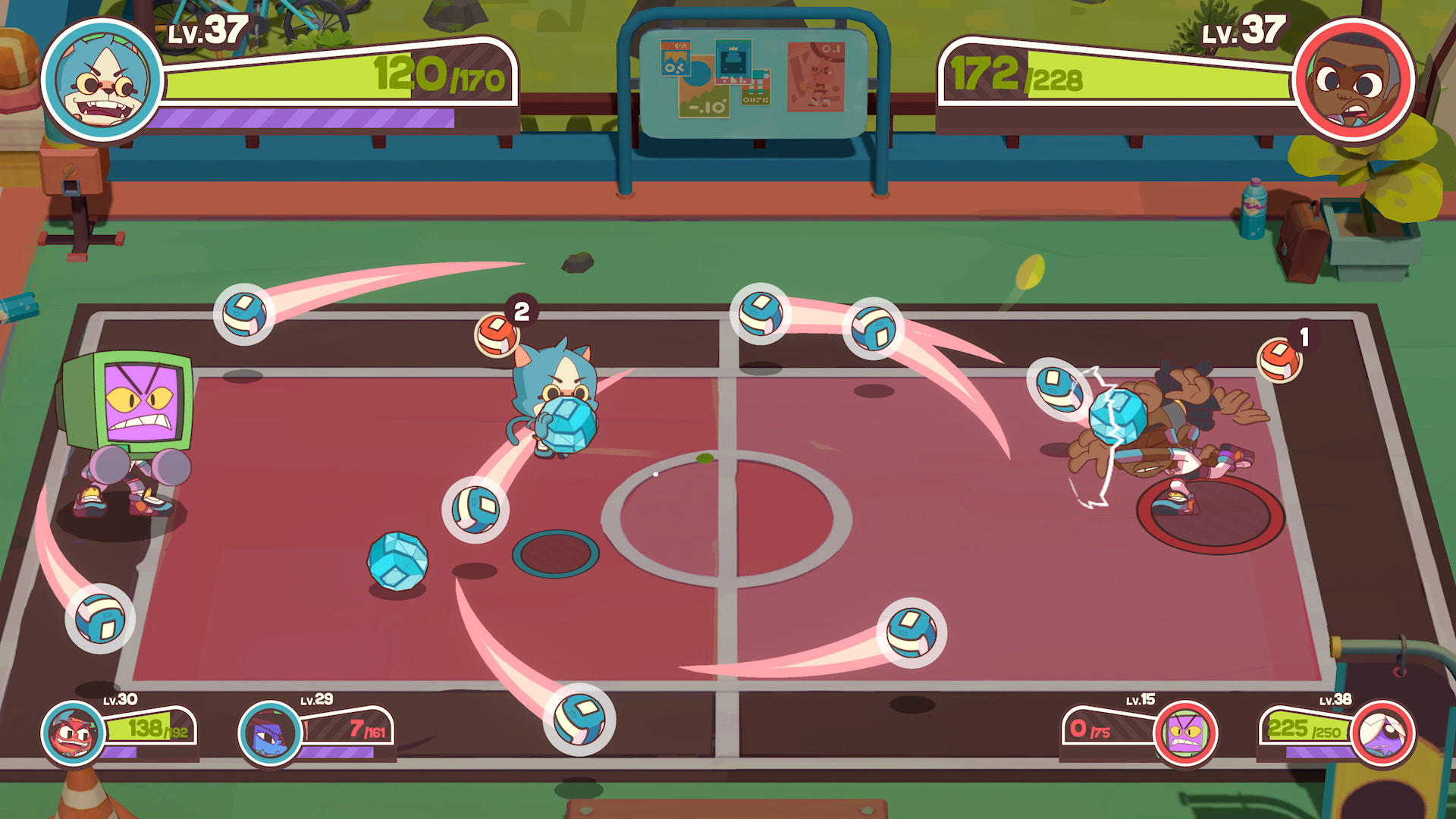
There is also some nice balancing with the combat too in that players who are knocked out will still be able to participate, albeit from the sidelines. This means that the further ahead you become, the more risky you need to play, since there will be balls coming at you from both sides. Additionally, you need to think more about catching and parrying rather than dodging, since, a simple dodge means that the rival team will likely catch the ball behind you. This works both ways of course as if you begin to lose, the same rubber banding can be applied to keep you in the game. It’s a nice bit of game design that helps keep matching intense until the final blow is stricken.

On the whole, I really like the battle system here and I would be interested to see what else the team is capable of should they take this approach to other sports. I’d love to see what they could do with rock climbing, or even something like table tennis or boules.
Sometimes it is brains > brawn
I mentioned earlier that this game was an RPG, and yet I haven’t really touched on any of the RPG elements, so let’s do that now. As you win battles, you will be showered with consumable items and some all-important EXP. This EXP fills up a bar which when filled, grants a ‘level up’ alongside a few stat boosts, innovative stuff, I’m sure you’ll agree. As you level up your party, you will gain new abilities which feed into the architype of that particular player, be that a support role, offensive or something else entirely. As with any RPG, it is always satisfying to watch the numbers grow larger and larger. Whether a party member participated in a match or not, they will still gain experience, allowing team compositions to remain flexible throughout the entire campaign. I stuck with my starting team of three, but it would be possible to swap these players out depending on the situation.

I should note that there were a couple of difficulty spikes where some boss encounters seemed to do far more damage than seemed reasonable, thus required a little bit of grinding to get past. It wasn’t too egregious, but I fell like game design has moved on from this battle of attrition which sometimes reared its head throughout my dodgeball journey. Of course, this could simply be my skill level not being up to scratch, I’m not so proud that I wouldn’t admit that.
As with any great RPG, Dodgeball Academia allows for you to customize your team however you like, using money earned from matches you can purchase and equip new charms, or purchase permanent stat-boosting items from various shops. Charms can also be acquired from completing side objectives and these, in my experience turned out to be far stronger than those that you can grab from the shop, as many of these come with a drawback which must be balanced into your style of play. There are typical “boost defence by X%” or “increase max health by Y%” charms but some of them break out this mould by offering buffs when balls are parried or caught, damage boosts when you enter the opponent’s half of the court and more.

As I mentioned, I wasn’t so enamored with the purchasable charms, which meant that by the time I unlocked the ability to purchase different juices from the shop and permanently increase damage output numbers, I went all in – potentially breaking the game. This being said, it must’ve been the developers’ intentions to use the store in this way as I still had a challenging time in the final match. I was expecting to waltz on through to the podium, but it wasn’t so simple.
It was also a neat addition that party members have a specific set of likes and dislikes, this alters the effectiveness of healing items and permanent stat boosts too. If, from the story you know that Balloony doesn’t like Hawaiian pizza, he will not be able to gain HP from eating it, Otto on the other hand might love it, meaning that he gains an extra 50% health when consumed. It is a fun way to introduce character traits, and it fits in perfectly with the playground setting.
An unlucky bounce every now and then
So, it seems like I like this game quite a bit so far, but sadly, that is not fully the case. Like with many other RPGs, some of which I adore, the length is padded out by semi-random encounters. Whilst it didn’t bother me so much because I found the matches to be satisfying from beginning to end for the most part, there is one flaw which I cannot excuse. The backtracking.
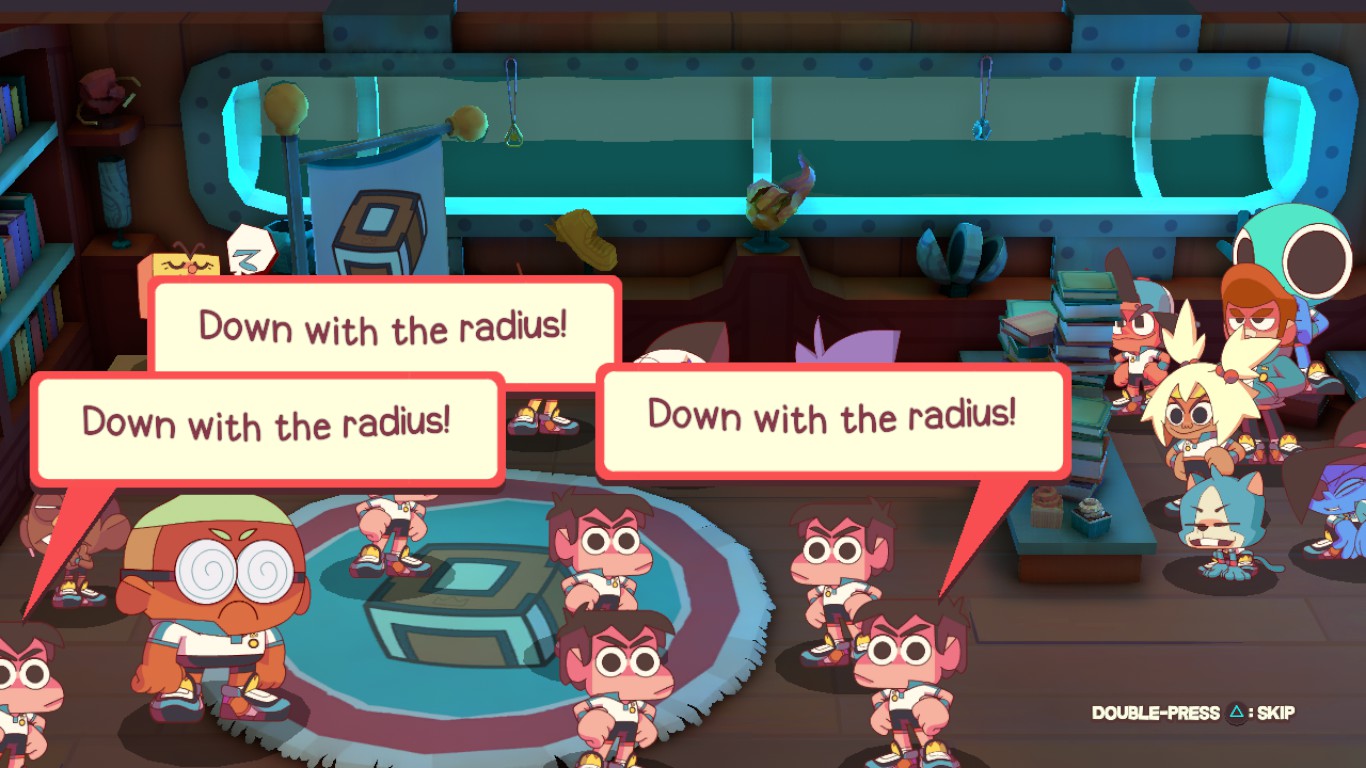
Many fantastic RPGs will have you going between locales, completing quests and discovering new areas. Dodgeball Academia tries to do this, but with the limited space offered by the school campus setting, you have seen it all within the first few hours. I longed to be let out of the school gates, and when this was allowed, this freedom wasn’t anywhere near as sweet as I’d have hoped. The constant back and forth from one end of the campus to the other, over and over was simply too much. No matter how much I like the sense of speed and inertia offered by the rolling move, it wasn’t enough. You could argue that Pokemon, a series I love is guilty of this same crime, but the scope of the world and different biomes and monsters you meet along the way keep this fresh and bearable. Dodgeball Academia doesn’t have this level of enemy variety, or locale variety, and I couldn’t stand the sight of the school gates as I got to even the halfway mark.
This significant down-side means that I can’t really recommend this game as highly as I wanted to. The lack of variety and significant back tracking which was likely the result of the indie budget just can’t sustain the length of the campaign. In a sequel, I’m sure they would expand on this further, and certainly with an investor behind them, they could do great things with this franchise, but it isn’t quite here.
Game, set and match
Dodgeball Academia is a great looking game with a fantastic premise, tone and combat loop. However, the barrage of repetitive busywork left me feeling much colder on the whole experience by the time the credits rolled. It makes me truly sad that I couldn’t love the game as much as I loved the premise and combat. That being said, it is going for pretty cheap and if you have the middle-tier of Playstation Plus, you can try it out for free. Maybe you won’t find the lengthy and repetitive quests drag the experience down as much as I did.
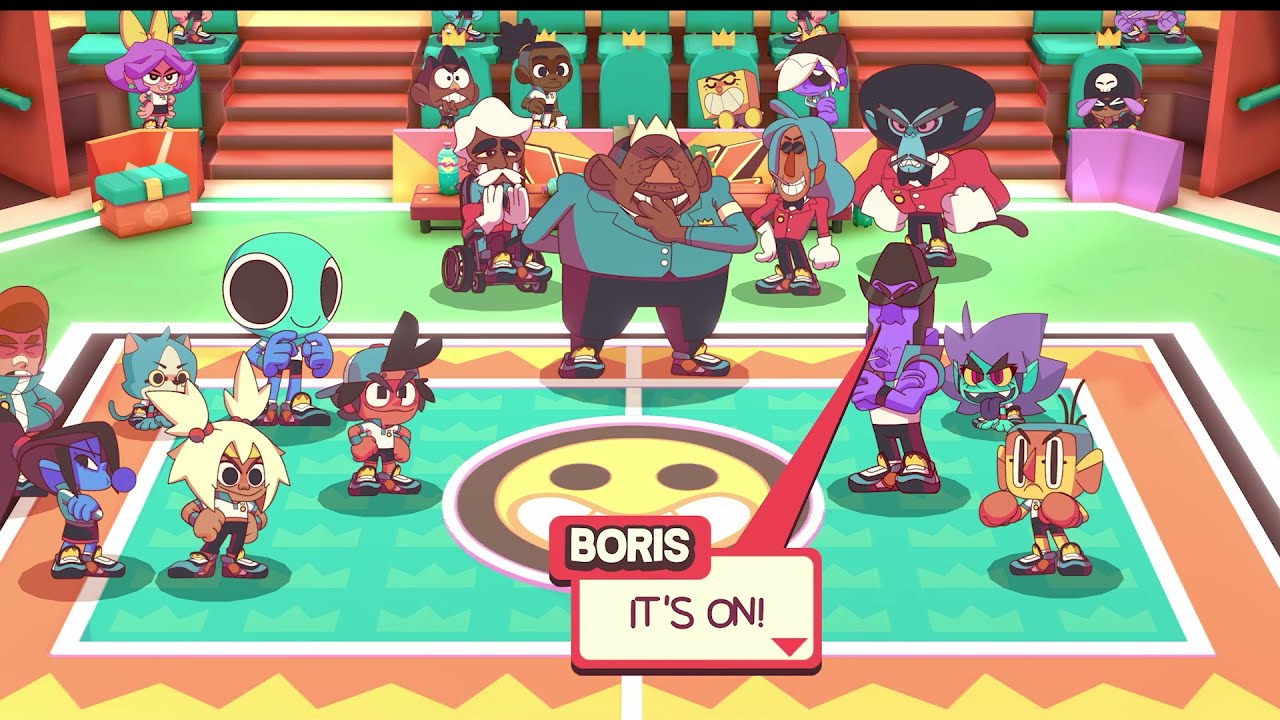
I’m excited to see what the team will be cooking up next though, and like a rabid fan at local sporting events, I’ll be there to drink, shout and kick up a fuss when the time comes.
 Lap Full of Crumbs