
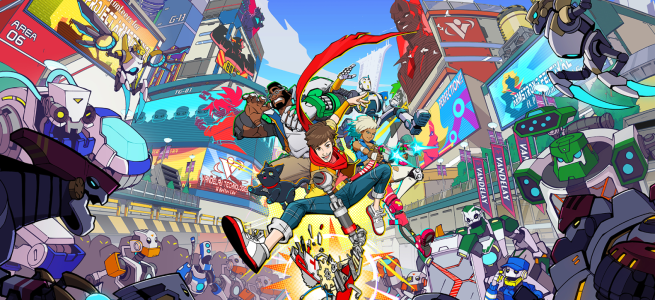
What do you get if you were to throw Devil May Cry, Scott Pilgrim vs the World and Guitar Hero into a blender? Other than a nostalgic cocktail of my life in the 2000s… The answer, by the way, is Hi-Fi Rush. The latest game from Tango Gameworks, the studio previously responsible for The Evil Within and previously headed up by survival-horror legend Hideki Kamiya. Originally released as a console exclusive for Xbox last year, in 2024, Playstation nerds such as myself have finally got a chance to give it a shot. I’m happy to report that this game rules, and I’m sure Tango are thrilled to have it in more player’s hands.
I’ll go into a bit more detail as to why this is absolutely worth your time, but as with any review, it’s all subjective and with this title more than any other, bear in mind, it feels almost tailor made for me.
The intro
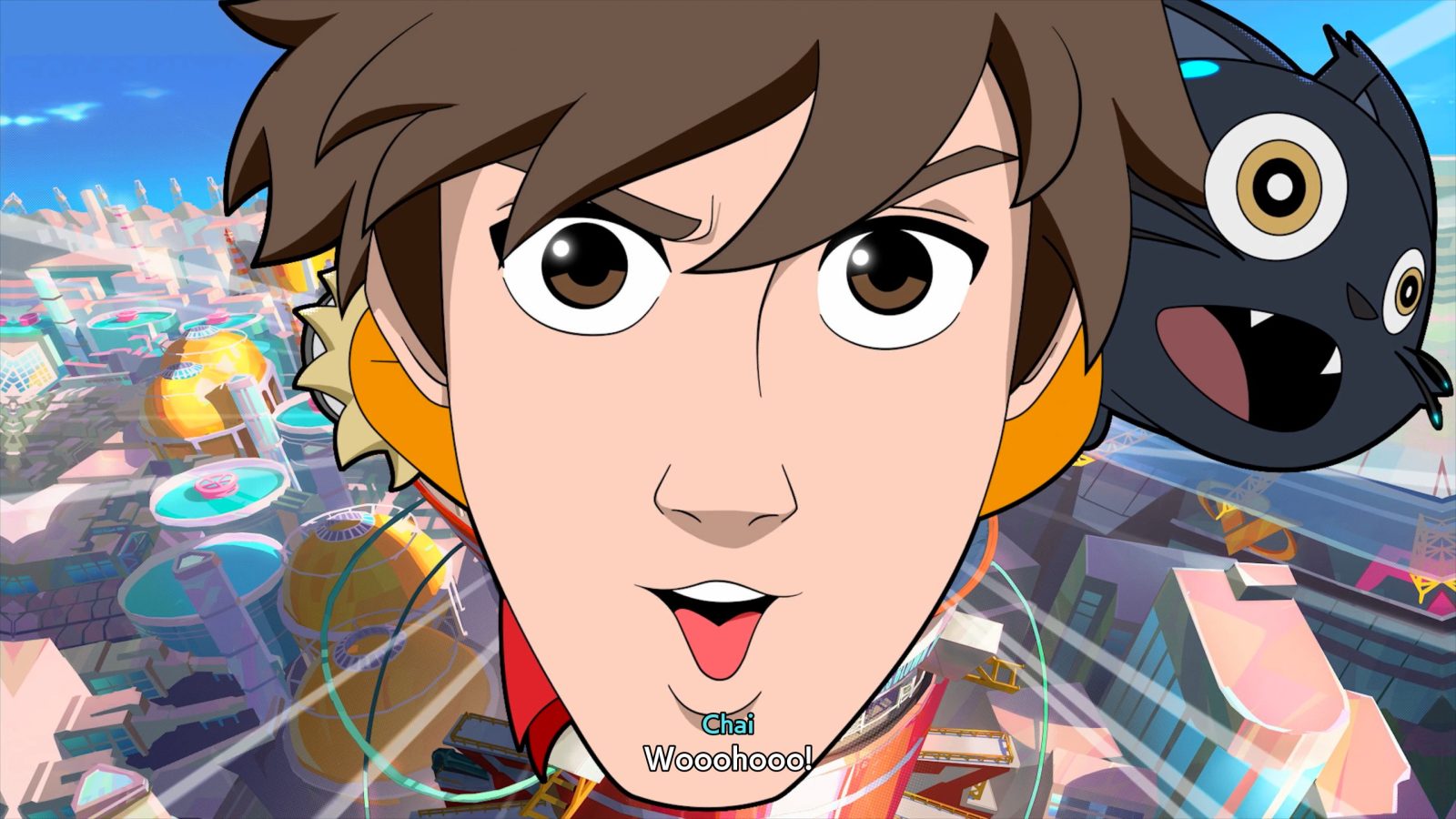
The first thing which strikes you when you boot this up is the visual style. Tango fully commits to the cell shaded, cartoony aesthetic, and it really puts your OLED screens to work. The first impression left by Hi-Fi Rush is amazing. Few games have an opening cutscene quite as engaging and entertaining as this. It begins as the riff of Lonely Boy by The Black Keys kicks in as we get introduced to our world, the protagonist, and the antagonists – encapsulating everything you’re going to see over the next 11 or so hours. It is colourful, funny, charming and energetic, with a heavy dose of indie rock bangers.
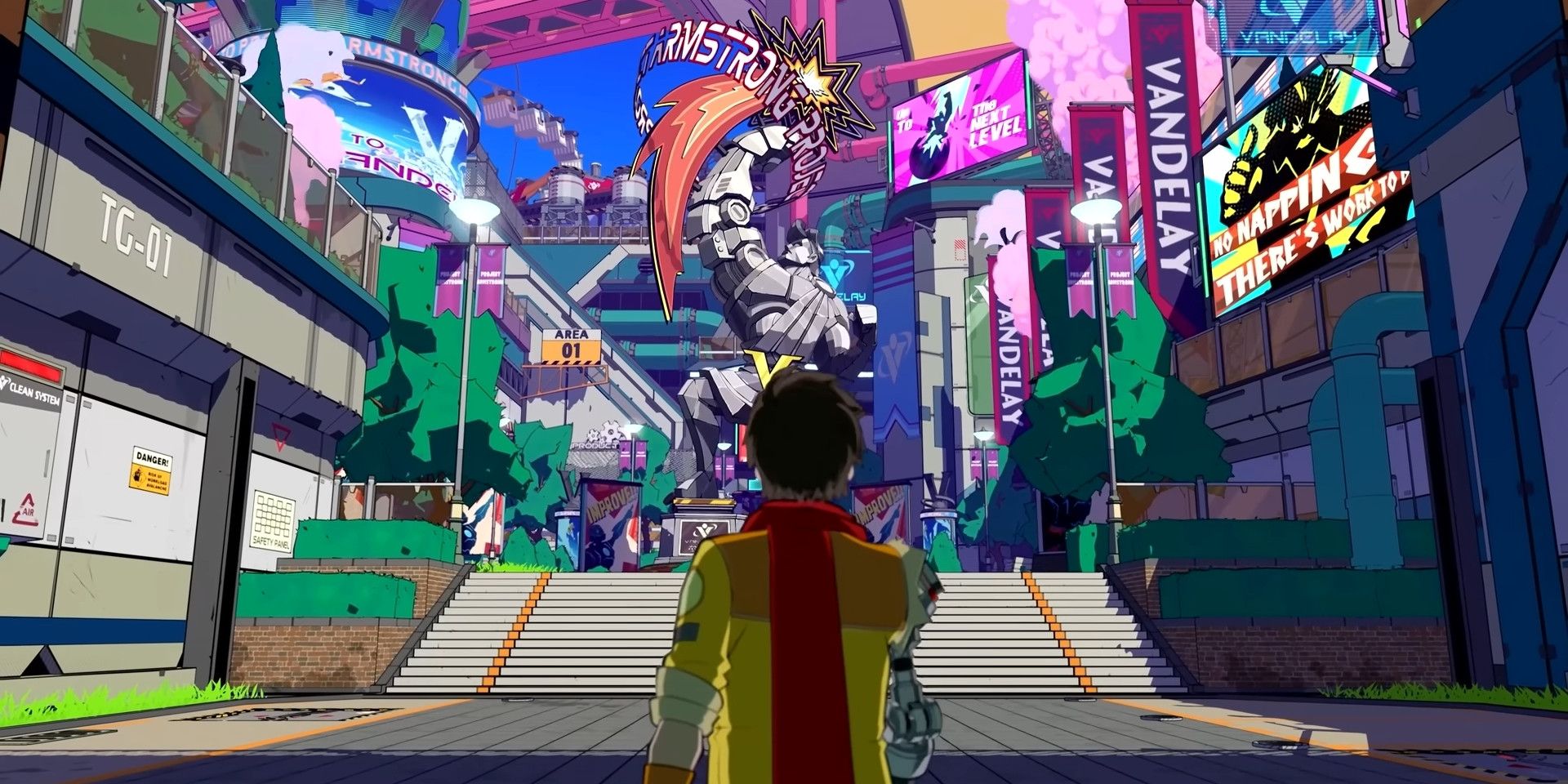
Each movement and impact is punctuated with a comic book flare declaring ‘clunk’, ‘bang’, ‘pow’ and each action is performed in rhythm with the soundtrack. Everything from character footsteps to exaggerated emoting, all in time to the beat. I’m going to throw in my Edgar Wright reference here and hit my quota. The tone setting is just as good as the opening of Baby Driver, another movie I love. If you can watch the opening cutscene without a cheeky grin on your face, you’re really not going to like what comes next.
Music to my ears
Now I wouldn’t normally focus on the soundtrack so early in a review, but it is so essential to Hifi Rush, it would be criminal to leave it as an afterthought.
Music is critical to everything in Hi-Fi Rush. All actions are performed in time with the beat, so without a soundtrack which makes you want to tap your toes and get in the groove with it, the game’d be sunk. Thankfully, the soundtrack rocks. The level tracks themselves whilst not overwhelming, each have an energetic beat for you to get into which ebbs and flows with each stage as you go from high-octane combat encounters to more thoughtful platforming sections. These aren’t going to blow your eyeballs out your skull like a Mick Gordon score, but I’ve grown to really love these tracks – many of them securing a permanent place on my Spotify playlist. Needless to say, they all pass the toe tapping test, and each of them escalates just as you would expect.
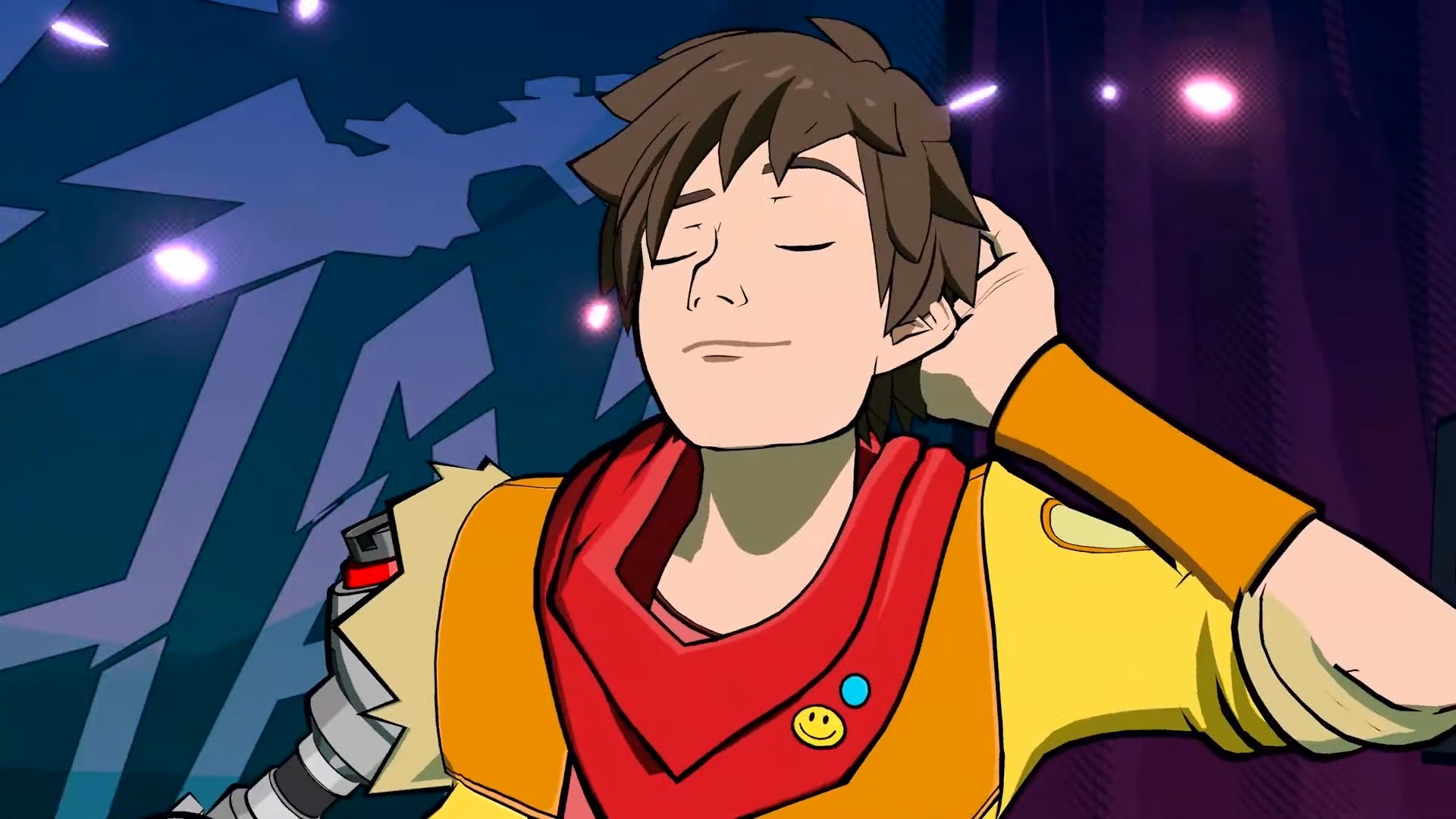
On top of the OST though, there are plenty of licensed tracks used, albeit not as many as I’d hoped for, especially given how effectively they are used. This is likely because of the licensing nightmare which comes along with using music in the way and Tango not wanting to nerf future versions of the game by removing these titles. There are a lot of songs here to love, with the likes of Nine Inch Nails and The Prodigy getting some love, alongside The Black Keys, mentioned earlier. Getting to fight in time with these tracks that I’m often extremely familiar was a blast, and the scores I achieved on those levels definitely reflected my relationship with the tracks on offer.
My hopes for a sequel include more of these tracks to be used in interesting ways and hopefully now that Sony has a foot in the door, we can utilise some of the bands under the Sony Music umbrella, such as; AC/DC, Foo Fighters, Bring Me the Horizon, or Blink-182. Heck, even Britney Spears or Adelle could feature in a stage.
Setting the stage
The story of Hi-Fi Rush is fairly straightforward, as discussed, it is more focused on building a world than telling a compelling narrative. That world which is created makes for substantial fodder for the game to chew through and keeps things interesting throughout.
You play as Chai, a charming and charismatic loser who just wants to play guitar and become a ‘rockstar’. Rather than doing this through hard graft, Chai enrolls in the Armstrong Program, an initiative set up by mechanical augmentation super conglomerate Vandelay Industries. This initiative takes regular humans, and gives them robotic limbs to allow them to work more efficiently, amongst other things. Of course, all Chai wants to do is have the robotic arm play guitar for him. There are some mishaps with the surgery that leads to an MP3 player being soldered into Chai’s chest and after being labeled a ‘defect’, Vandelay tries to dispose of him – by force. With the iPod stamped into his chest, Chai becomes superpowered with the beat of his music and the world begins moving to his own beat, and finally, he can begin to rock out and beat people senseless with his guitar made of trash. During the opening hours, it is clear that things aren’t quite what they seem with Vandelay, and thus, the ragtag team of punks set out to take down the corporation.
What Hi-Fi Rush lacks in narrative originality, it more than makes up for in characters. From your teammates in Peppermint and Macaron to the antagonists who each showcase their own quirks, everything is so over the top, it is hard not to be taken along for the ride. I haven’t even mentioned 808 either, the robotic cat sidekick who is awesome and adds a Disney-esque mascot character ripe for the production of plushies, keyrings and so much more. I love 808, and I’m very much a dog person.
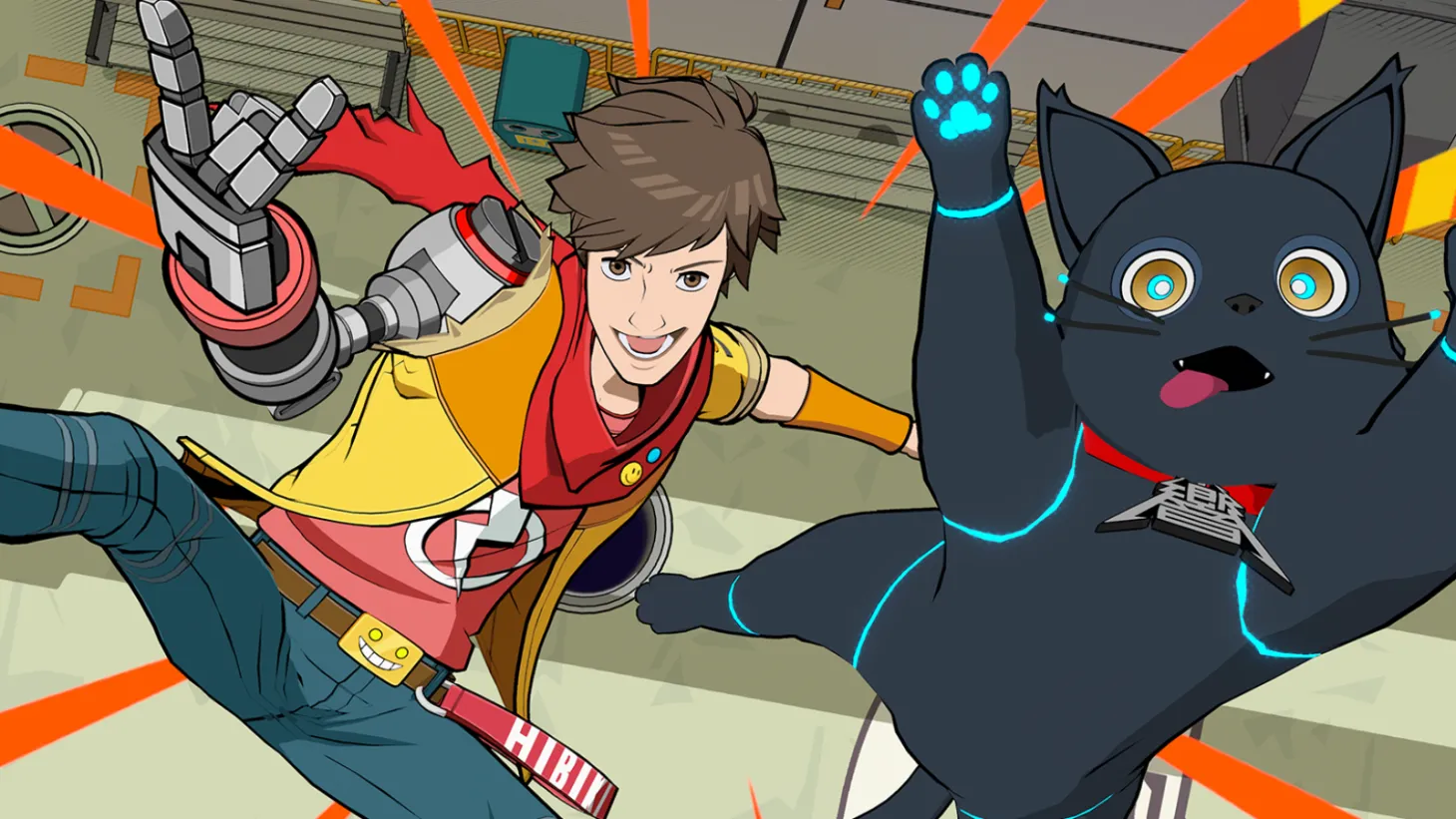
So, the premise of “ragtag team try to take down dystopian megacorporation” isn’t exactly original in 2024. There is genuine heart in here though. The climactic scene leading up to the final confrontation legitimately made me feel things, helped in no small part by an excellent song choice I’m sure. Not only does it feel genuine in its sincerity, but it is also quite funny. Whilst many jokes may cause you to roll your eyes, there are some lines which caused more than the nasal exhale I’d usually retort with – I genuinely laughed. There is some great voice acting on show here and the comic timing combined with the expressive art style makes for some chortle-inducing scenarios.
Big beats are the best
The combat in Hi-Fi Rush is fairly standard from the ‘character-action’ genre, it is all stuff you’d come to expect – light attacks, heavy attacks, dodge-dashes, parries, air juggles, pause combos, they’re all present and correct. Where Hi-Fi iterates on these however is by infusing the rhythm game DNA into the mix.
Chai can only attack on the beat of the music, with light attacks taking one beat to execute, whilst heavy attacks take two beats (one for a wind up). This rule set, combined with enemies also having to adhere to the same rules, makes parrying, dodging and predicting attack strings far easier. Cheesy as it is to say, you only really get good at this game when you start to feel the beat, man. If this sounds intimidating, don’t worry, there are handy cheers from the crowd and plenty of visual feedback to ensure that both your eyes and ears know when you are in or out of time. There’s also the option to pull up a metronome at the bottom of the screen, which makes the UI look slightly messier, but I really appreciated the extra support – me having no rhythm at all.

It is perhaps most commendable that being out of time with the music is not punished in Hi-Fi Rush, instead you are rewarded for being on the beat with additional damage. This sounds like a small change, but I can only imagine how frustrating it must be to try and play this game where hits only register if performed on the beat. There’s a challenge level which has this modifier on and I never want to do it again.
When you are able to dodge, duck, dive, dip and dodge around your enemies’ offenses, it’s time to punish with your own skills. Each combo Chai performs finishes with a ‘beat hit’, this is almost like a ‘quick time event’, but obviously in time with the music. If executed correctly, you’ll be rewarded with a huge, crunchy attack and an onomatopoeia splashed over your screen to let you know that you rock. This stuff feels awesome, and is one of the main hooks which kept me engaged from start to end.

There are also character assists which you can call in at any time and the obligatory ‘super meter’ (in this case called ‘reverb’) which allows you to pull off flashier attacks. As is standard fare for the genre, you can cash in smaller chunks of your reverb bar for additional damage, or save it and blow it on something that looks far more extravagant, show-stopping, if you will.
The character assists are where I think HiFi Rush feels a little messier than it needs to. These operate on a cooldown, meaning that you can’t spam them, but any moment they’re not on cooldown, you are missing out on potential value from these. It might just be my min-max brain, but at no point in combat was I not cycling and popping these abilities the second they became available. This is exacerbated by the inclusion of some enemies which need to be hit with specific assists multiple times, leading to a bit of down time in some fights where you can’t do anything but wait around. A mechanical nit-pick for sure, but one that I felt should be raised – even if the chaos of calling in help from your whole squad at the same time did make me laugh as their audio cues stack on top of one another.
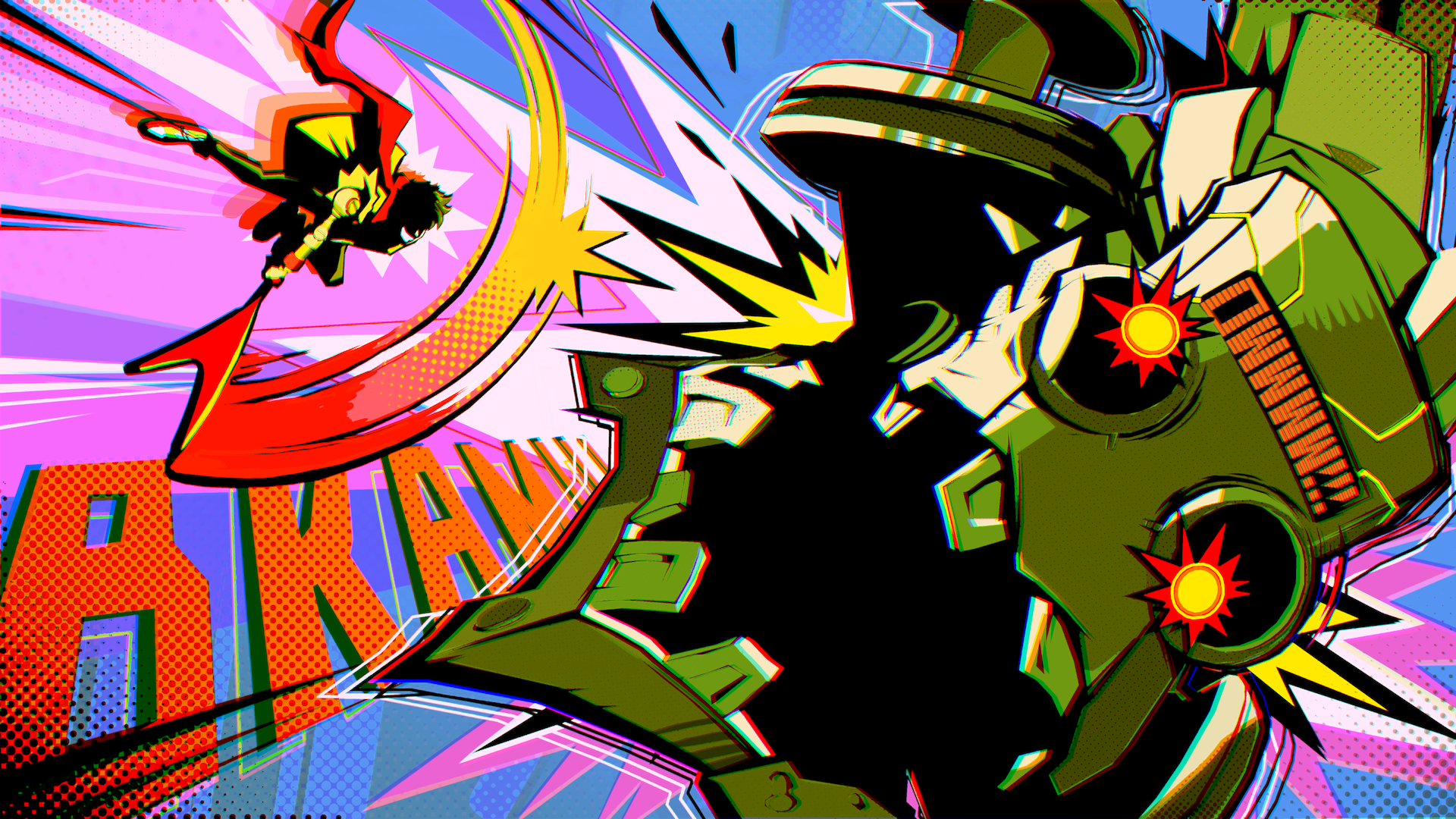
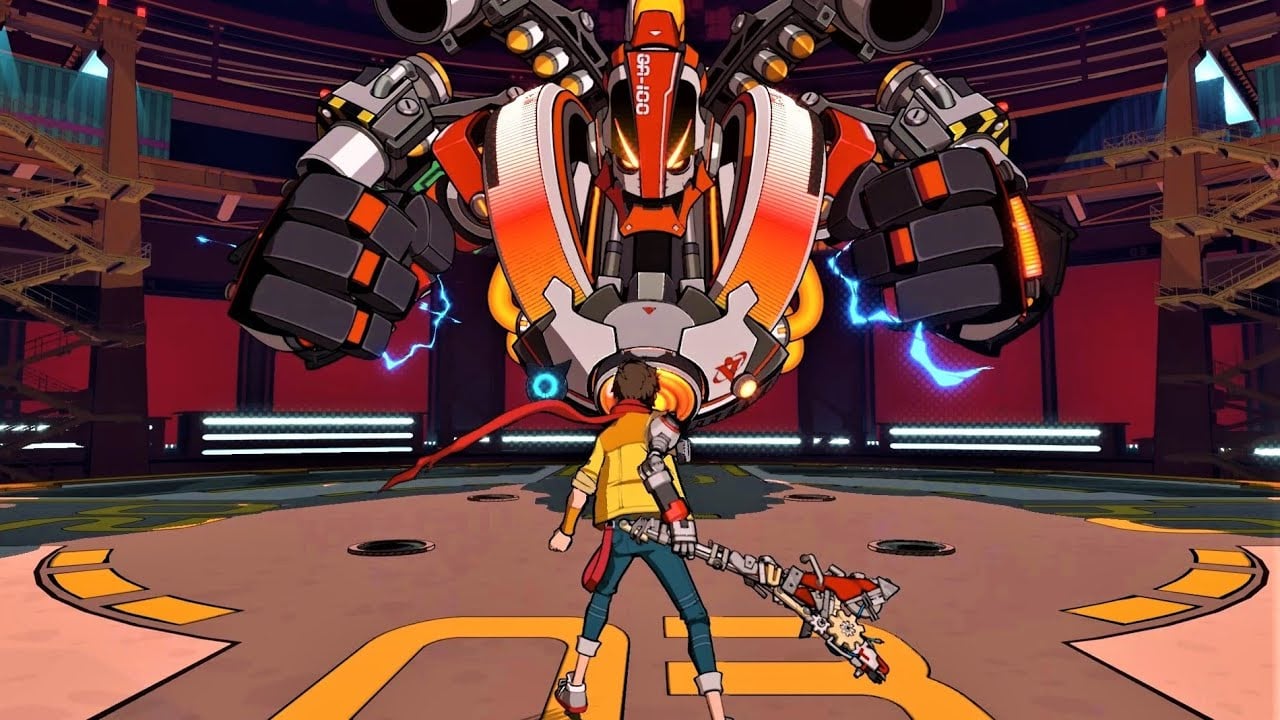
Bosses are also present across the campaign, usually occupying the last leg of a particular chapter. Every one of these bosses is fought to the tune of a real-world licensed track, and most of these hit for me. There are some great choices, and some which I don’t know so well. The fights themselves are all interesting and have been injected with the style you would expect, especially as the foe powers up into their final phase. The last boss in particular is a real highlight for me, I won’t spoil the song choice, but when that started up and the credit popped up, it was GO TIME. The difficulty of these bosses also scales appropriately, with the exception of one which felt like a large spike before heading into the final act (if you’ve played Hi-Fi Rush I’m sure you know the one). There’s no gimmicks, no frills, it is all excellent.
Dull notes?
One of the only staples of the character-action genre which isn’t included in Hi-Fi Rush is that there’s no lock-on system. There is a soft lock-on system in the works behind the scenes, but even that gets things wrong sometimes. I had several instances where attacks would go towards enemies I did not intend – be that hitting shielded enemies instead of those who are vulnerable, or wailing on a heavy threat rather than clearing out the weaklings like I intended. It isn’t a super big deal, but it was annoying when it happened. I wonder how much different the game would feel with the ability to lock-on to enemies using the right stick, maybe I wouldn’t even use it, but at least I would have more control.
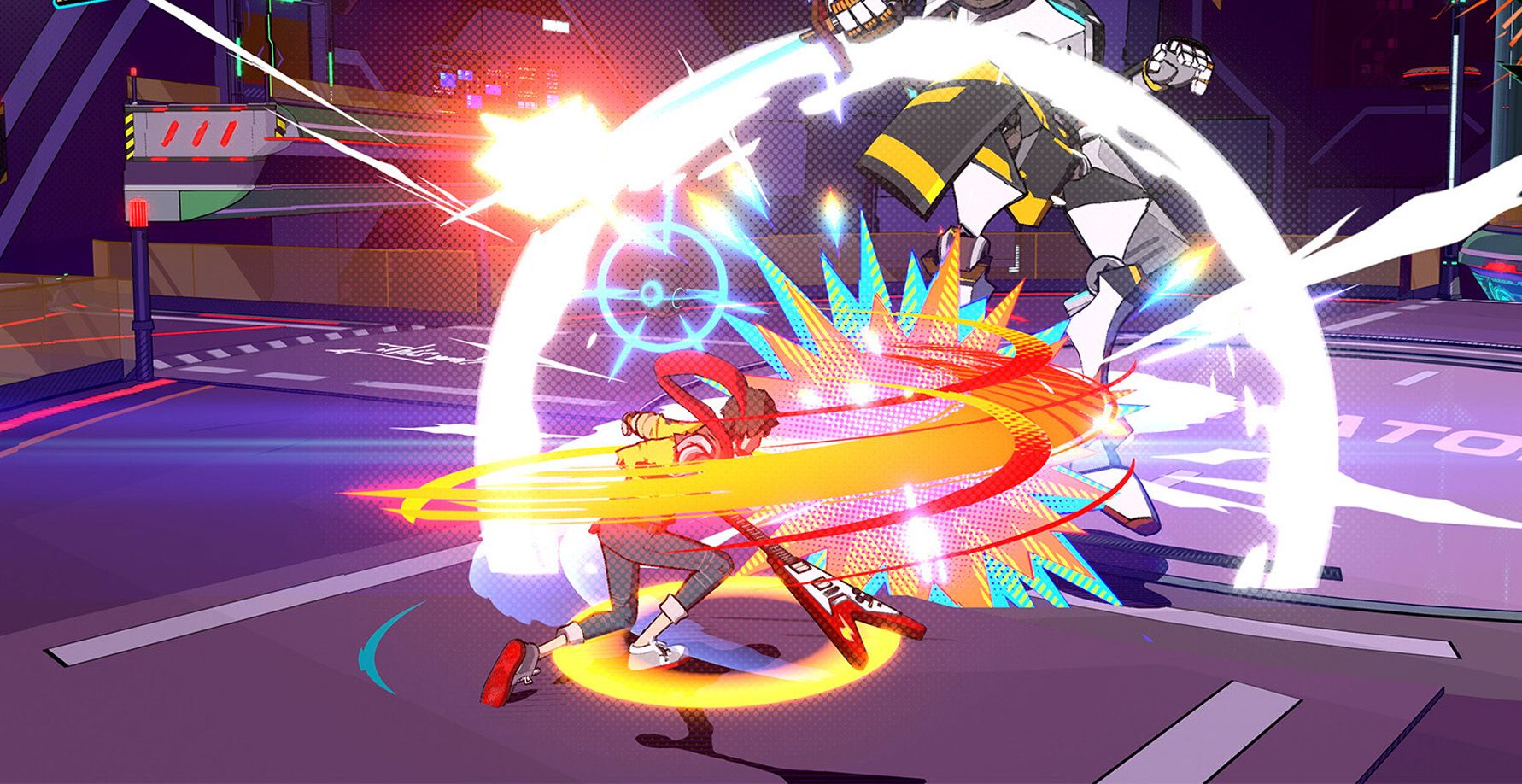
Another quirk which I found quite odd is that you are unable to grapple off-screen enemies. The grappling hook allows you to quickly zip around from enemy to enemy and carry on building your combo meter, good for score, and your ego. Being a fully-grown adult human with object permanence, I know if there are enemies behind me, and by turning Chai and hitting the grapple button, he would never go the way he was facing, only the way the camera faced. This is certainly a ‘me’ problem, but given that enemies can hit you from offscreen, it feels as though I should be able to do the same.
Given the concept of Hi-Fi Rush being so imaginative, it is a shame that the Vandelay campus is relatively bland in what is on offer. You’ll spend a lot of time going through industrial corridors and factories and the levels themselves are never the star of the show. There’s a nice museum stage, and an obligatory lava level, but nothing which has the same level of inspiration as the rest of the game. It would’ve been awesome to see something more unique placed in here, the marketing department for example could be set during a focus test and have different demographics rework the surroundings. This would be ripe for jokes too – when children are asked, they might want shark tanks or puppies, whereas Scandinavian interior designers may want something a bit more minimalist.
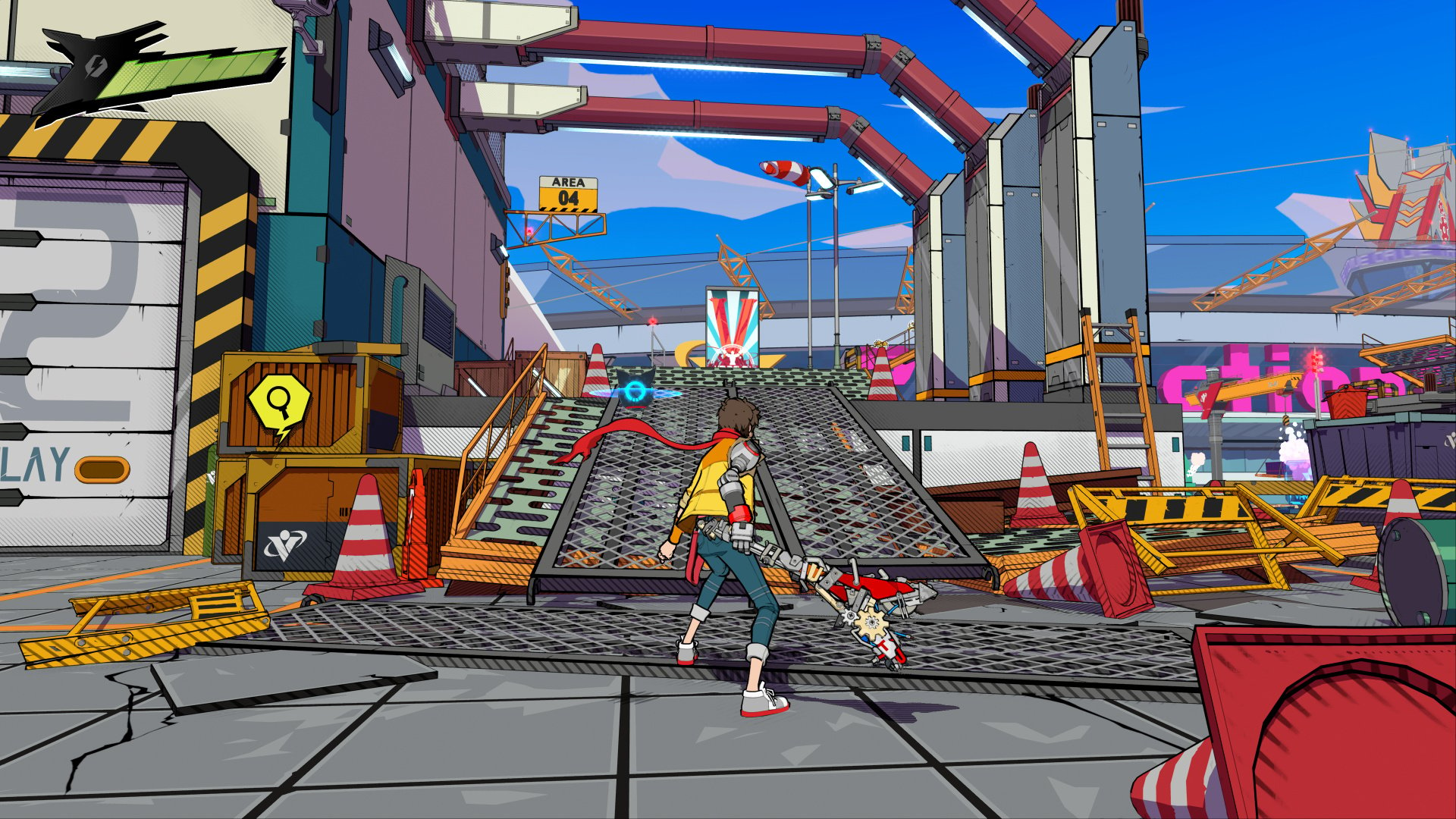
Despite the combat being excellent in almost every regard, it should be stated that there is a surprisingly large focus on platforming, particularly in the first half of the game, this makes the pacing feel a little wonky particularly in these sections. Thankfully this picks up significantly in the second half and when viewed in its totality, is paced a little more like Free Bird by Lynyrd Skynyrd rather than Psy’s Gangnam Style which just goes all in from the start.
Hi-Fi Rush is not as deep as other giants in this genre such as Devil May Cry or Bayonetta, but it doesn’t have to be. The simplicity of its combos allows for you to focus on staying on the beat, not being frustrated at input errors, and truly getting in the groove.
Be kind, rewind
Once you are done with the main campaign after about 10-ish hours or so, there are plenty of reasons to revisit levels, and you will. On the second playthrough new challenge rooms become unlocked in each of the levels for you to hunt down as well as higher difficulty modes if you wanted to test your skills. These challenge rooms are often devious in the modifiers you are required to adhere to – take no damage, don’t touch the ground, stay on the beat for >80% of the time, etc. These challenges are not so plentiful but to be daunting, but I was wanting to play the campaign again because it was so fun anyway, may as well go after these too. Completing these challenges is absolutely worth it too, I won’t spoil that here, but what you get afterwards is a nice reward. There are also collectibles littered throughout the levels which allow you to increase your various stats, or grant rewards like new graffiti for your home base – ultimately, your curiosity and drive to explore is almost always rewarded.
That’s not all though, there are plenty of alternative combat challenges to dig into too. This is where the majority of my revisiting of the title is likely to happen. Modes specifically focused around beating up robots – it remedies the focus on platforming which is present across the campaign. This is all killer, no filler. First up you have BPM Rush, a series of combat encounters which escalates in the BPM of the music you are brawling to ludicrous levels. This makes for the fastest way to play by far, similar to ‘turbo mode’ in the Devil May Cry series. Of course, at the end of the stages, you receive a score and grading, which you’ll naturally want to go back to beat. This mode was so good, it was so much fun, that I swear I got an RSI from playing too many consecutive rounds.
There is also a rogue-like mode and a straight-up Bloody Palace equivalent to keep you coming back for more and chasing higher and higher scores. These are perfect accompaniments to the rest of the game, giving iterations on, but not overshadowing the fantastic combat which underpins everything.
Overall though, the replayability in HiFi Rush comes from it just being so dang fun to beat up robots.

The rewards for getting involved with these extra modes, other than just the fun of it all, is kitting out your wardrobe with additional costumes, new music tracks to play in the hideout, all good stuff. Some of the costume options are great, but I do wish there were just a few more to really make the merry band of rebellious teens my own. Want them all dressed as super heroes? You can do that. Want them to look like a jazz band, complete with pinstripe suits? You can do that too.
The outro
Go out and play this game. Don’t let the rhythm aspect put you off, I really do not have any rhythm and can’t play any instrument, but I had a blast with this. Hi-Fi Rush is so fun, and we need more games like this, the “sad dad” games have their place, but we have had enough of those now.
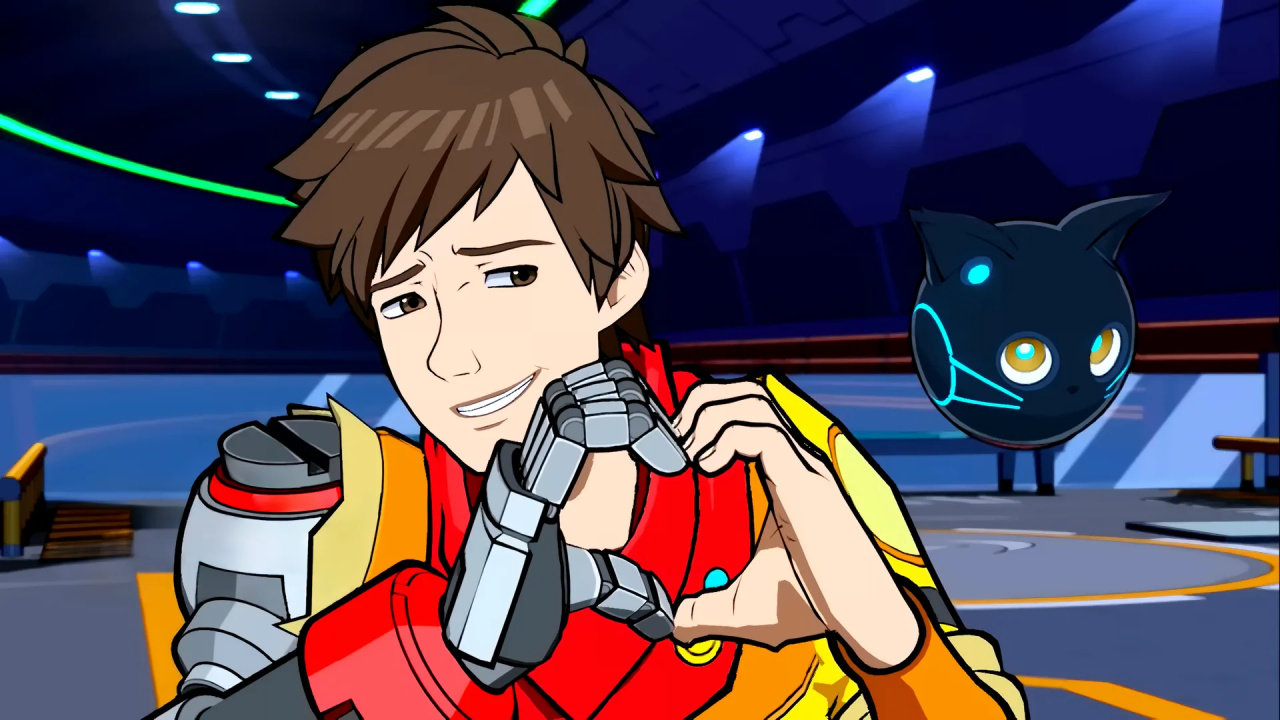
Much like Limp Bizkit, what feels like it should not go together actually works in perfect harmony. Rap & rock, character action & rhythm games – it works. That’s the quote for the front of the box I think;
“Hi-Fi Rush is the Limp Bizkit of video games”
(Written before the unfortunate news about Tango Gameworks)
 Lap Full of Crumbs
This game always looks so vibrant, I need to play it one day. Such a shame that the studio was closed – gives the impression that breaking the mould is not allowed, when it should be encouraged.
LikeLike