
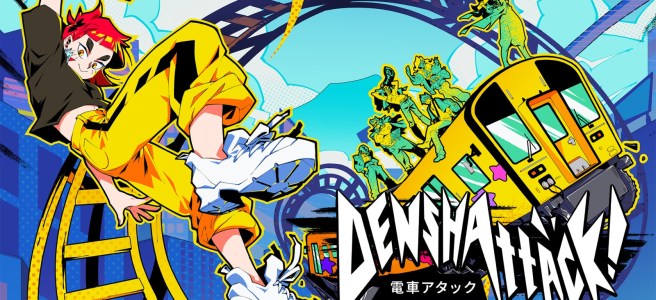
Living in the UK where travelling by train is notoriously unreliable, uncomfortable, and extremely expensive – it is no small feat that Denshattack manages to make me think that trains are the most badass, punk, and flashy modes of transport out there. I’ll break down the formula in more detail later, but it feels to me like the hybrid baby of Sonic the Hedgehog, Skate and Jet Set Radio – but more on that later.
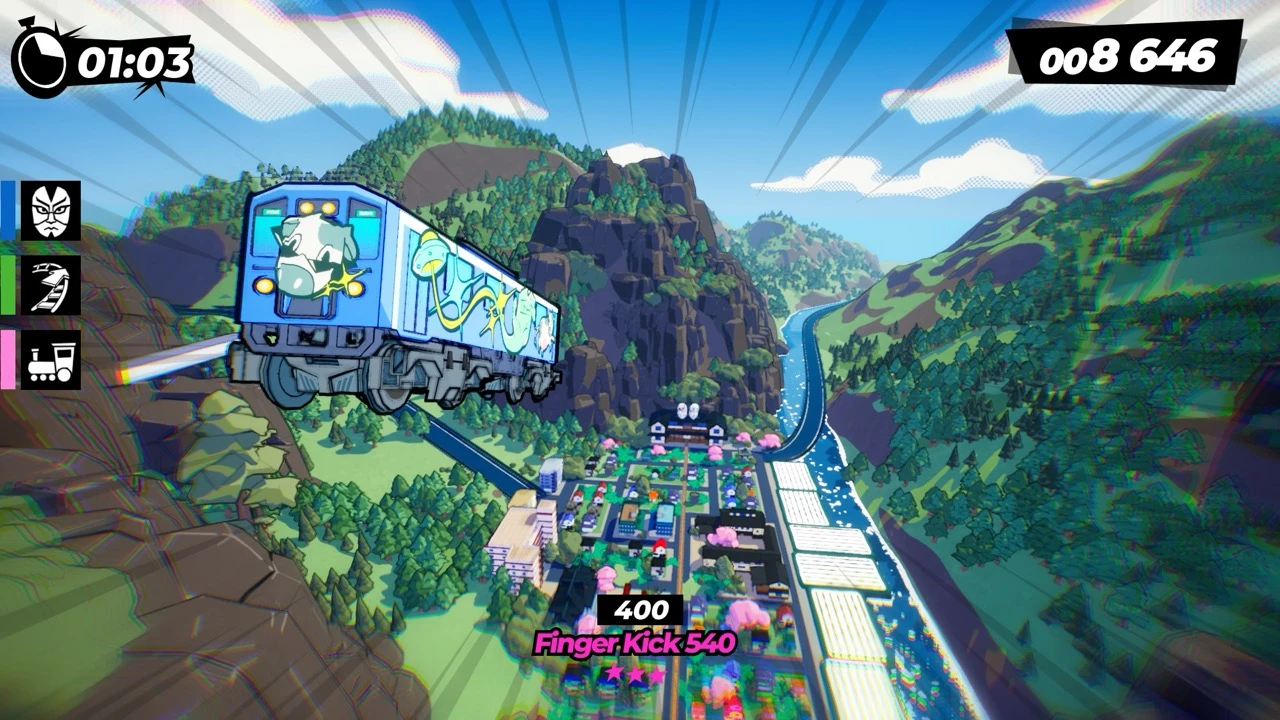
Desnhattack allows for a lot of player expression thanks to fantastic game design and a clever integration of systems. An odd statement coming from a game which is quite literally “on rails”. Denshattack isn’t content to just stay on the tracks placed by big corporations though, how you break away from them is equally as exhilarating, illustrating how liberating it can be to break away from well-trodden ground, the tried and true.
Honestly, this game lit me up and filled me with such an immense sense of optimism which is becoming exceedingly rare to find considering I’m a 30-something year old man living in some pretty grim times. I just really want to talk about it.
Mind the gap
You play as Emi, a young drifter who delivers ramen around her home prefecture in her trusty train. Upon delivering some hot broth to a budding journalist and overall train enthusiast you’re introduced to the world of Denshattack.

You see, the majority of Japan’s population has taken shelter in massive domes which cordon off entire cities from the outside world. These domes were erected to avoid the fallout from the “climate disaster” which is feeling all too real in 2026. What infrastructure remains in the outside world essentially becomes a skatepark for anyone who still owns a train, if you see some rails out there, you can ride them. Naturally, these aren’t maintained in any way, so there may be times you need to traverse on things which aren’t a typical train track, but don’t worry, it’s so rad you won’t even question it.
After Emi ignites her passion for Denshattack, she realises she doesn’t need to stay at home working a delivery job for her grandma’s ramen outlet, but instead needs to find her own people. Thus begins the country-wide odyssey through rival gang’s terrain to hone your skills and become the best denshattacker out there. There’s some political intrigue there too, and plenty of big corporations to take down as you “stick it to the man”, but the basic premise is pretty straightforward. It’s your typical coming of age story.

Just because it is typical though, does not mean that it is ineffective. The gang members you meet along the way all have their own stories and reason for tagging along as you venture north across Japan. Everyone is intriguing enough, and all of their designs are so slick, they’ve become usual subjects for me as I try and teach myself some digital illustration skills.
The story doesn’t even need to get in the way though if you don’t want it too. There were plenty of times where I was a little lost as to what was actually occurring. This is the result of dialogue being delivered at some particularly stressful parts of the game. It makes it difficult to concentrate on keeping your combo up, stopping your train from careening into the ocean and taking in the narrative all at once.
Style and presentation
Needless to say, the presentation of Denshattack is a far cry from the drab exterior of the Transpenine Express or LNER which I’m used to seeing whenever I enter a train station. Everything here is so cohesive, each element wonderfully compounding the attitude the developers wanted to put forward. Whether it is sublime character art, awesome world design or dynamic menus, Denshattack sells the punk rock attitude in a way which hasn’t been seen so effectively since the classic Burnout games, or in Sega’s heyday.
The only ‘miss’ for me, which totally isn’t a big deal, is that the cutscenes here did feel quite stiff. I understand the constraints, but even for the comic strip style they were going for, there was a significant lack of energy here. When contrasted with the rest of the game, this really stands out. There aren’t too many of these though, and I wouldn’t dock any points because of it. It is simply because for my tastes, I’m really struggling with things to seriously critique.
Rocking tracks
All of this style and “pizzazz” is further amplified by the stellar soundtrack on offer. Denshattack has kickflipped its way into a pretty exclusive club of video game OSTs. A club reserved for soundtracks which I will listen to after my time is done with the game, even after attaining the platinum trophy and already hearing these songs myriad times when trying, and failing, to obtain those elusive gold medals. If you’re curious, some examples of other soundtracks I hold up there include Metal Gear Rising, Hi-Fi Rush, Devil May Cry, TMNT: Shredder’s Revenge and more.
This soundtrack is filled with as much punk energy as the equally outstanding artwork. When the tracks want to rock, they rock. When they want to hyper pop, they hyper pop. When they want you to feel the power of friendship, you better believe they make you feel the power of friendship. The most recent example of a complete mesh of visuals, personality and presentation done to this degree would be from the Splatoon series or Bomb Rush Cyberfunk, and for my money, Denshattack blows them away in this department.
It helps that the soundtrack is so varied depending on what you are doing and which region of the map you are currently driving around. For example, if you are in the turf of the fashionable gang led by Yoshie, the soundtrack reflects this with some bouncy pop anthems to bop along to. Contrast this from the levels which take place in the ‘Tarantula’s’ territory where you will most likely hear moody industrial rap rock. From pop, rap, techno and even glam-rock, Denshattack has a little bit for everyone.
This varied soundtrack means that it can’t just be handled by one musician, talented as Tee Lopes is, I think even this might be a bit of a stretch. What this leads to is a mix of artists, best suited to their genre, all coming in at the top of their game. It rules. You will be listening to this soundtrack as you work on your spreadsheets or whatever it is you do for work, trust me.
Livin’ la vida loca-motion
So, we know the game looks awesome and sounds even better, but how does it play? It’s a game after all, that’s pretty important and a small studio like this must’ve dropped the ball somewhere, right? Right!?
As I stated at the top – Denshattack is a hybrid creature which would be the result of if you were to combine: the speed of Sonic the Hedgehog, the satisfying ‘flickit’ trick system from Skate and the rebellious energy of Jet Set Radio. If that sounds intriguing to you in any way, well, my job here is done, go out there and buy it – it’s so cheap and you’re going to have a blast.

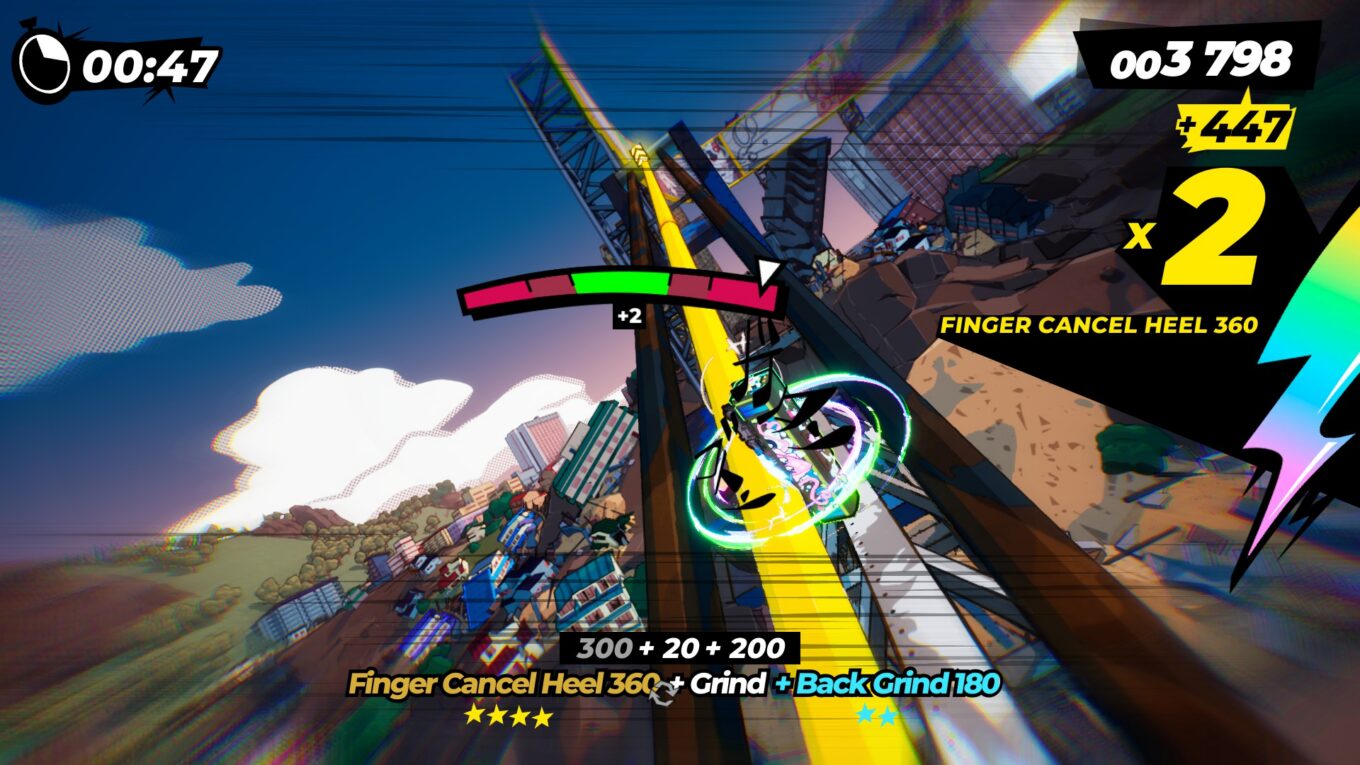
So that homunculus I just described might seem a little eclectic, but it comes together wonderfully when playing. The controls are simple and intuitive, contrasting with the excess that you might see on screen. The right trigger acts mainly as your jump button, your left trigger is the brake and the sticks each allow you to change tracks or do tricks. Tricks are performed similar to EA’s Skate, with more complex movements resulting in more extravagant stunts and in turn, more digits in your score counter.
All other actions are easily understood through those principles, for example, to drift across two parallel tracks, you need to brake to initiate the drift and use the ‘trick stick’ to swing your train out to whichever side you desire. It’s easy to grasp, and layers of complexity the game adds comes from knowledge of the systems and reflexes, and very rarely will your success rely on the execution of complicated inputs.
The result of this simplicity means that Denshattack has an incredible ability to get you into a flow state almost instantly, erasing the barrier between player and game (as much as a game about kickflipping a train can at least).
Trains on tour
As you work your way up the map, you encounter stage nodes on the map. These are one of four level types: a straight point to point level focusing on survival and navigation, a skatepark-style score attack challenge, an open-ended “complete the objectives” stage, a race which rewards you for going as fast as possible, or a boss fight (more on that later).
Each of these stages are always fun to complete because Denshattack is just so dang fun to play, but if I had to single out a weak link here, it’d be the open-ended missions. These can be quite frustrating to optimise if you’re going for all the collectibles or a high score as it is really difficult to place yourself in such a chaotic environment and working out the most efficient route to where you want to go is nearly impossible without some trial and error.
The other level types are different spins on the same formula, and you won’t go far wrong with taking the same approach to them – keep a high combo going, don’t break too much, and don’t crash. Follow that advice and you’ll be golden. This is much easier said than done of course.
Though this may sound repetitive and not a lot to sustain a fairly lengthy adventure, Desnhattack does a great job of introducing new ways that you can handle your train, whether that is new ways to drift, the ability to traverse the roof of any cylindrical environment or even swapping gravity to ride tracks upside-down. The result means that future levels can become more and more complex, but there are no true difficulty spikes since they’re introduced one at a time, with levels designed around getting you comfortable with each before mixing them in. The final levels for example are an amazing culmination of everything you’ve learned and nailing those without a single crash feels incredible.
For a game like this, the inclusion of boss battles might seem a little out there, but they rock. Seriously, these boss fights are up there with the best I’ve played in recent memory. I hold Metal Gear Rising up there as having the best boss fights in any game ever, and Denshattack, whilst maybe not reaching quite the same heights, does succeed in capturing the same style of scale and hype.
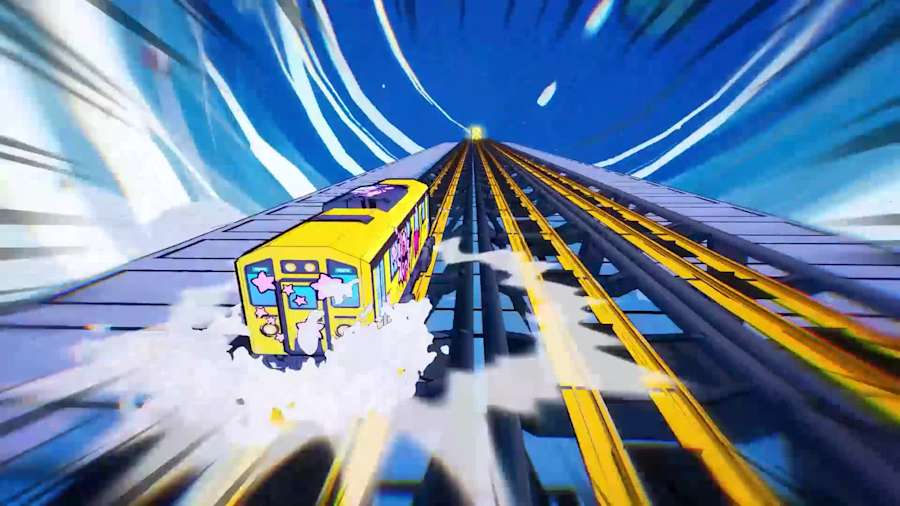
These boss fights range from battling a “megazord” composed of train carriages, a giant mechanical snake which shoots baseballs or a duel within a tornado and many, many more ludicrous scenarios. These are the real highlights of the game, and I won’t spoil anymore than those, but I looked forward to facing off against every gang leader who dared step in my way.
Each level has a few things for you to do, which encourages replaying levels you haven’t quite mastered yet. There are three medals to achieve, one focusing on time taken to complete a level, the score achieved at the end of a level and an exploration medal which requires you to find all collectibles and accomplish certain “dares” or challenges. These dares include doing a certain trick, or finding a secret pathway, there’s loads to get stuck into. The collectibles come in a few forms, gears which are used to unlock new trains, spray cans to customise your trains or movie reels which populate an in-game magazine and help flesh out the world even more, giving you a more intimate look at some of the gangs you’ll be taking down.
Customisation here comes in a few forms, either new trains (which offer different benefits and drawbacks) or new decals in case you feel like a single colour isn’t enough and you’d prefer more UFOs, cows or squids on the side of your locomotive. I didn’t play around with the different trains all that much, I was more than happy to stick with the default train. There are a few exceptions to this, but that was only to achieve various medals, one for example negatively impacts your score, but gives you more chances to achieve a “flawless” run.

Obtaining all of these medals for each level will take you a few tries normally, and only a few came close to being frustrating by the end of my journey. Normally though, I found revisiting old levels to be exceptionally satisfying as it became easier to maintain my combos and the sense of speed became much more manageable. It’s not dissimilar from learning a sport like skateboarding or skiing, at first it all feels lightning fast, out of control and unwieldy, however, spend some time to hone your skills and those beginner slopes feel far slower. The way that I could breeze through earlier levels when going back to get all the gold medals really speaks to my growth in skill and allowed me to be far more expressive rather than just trying not to crash. The sign of a truly great extreme sports game.
Final thoughts
If it isn’t clear – I love Denshattack. It is tailor-made for my tastes and I have been excited for it since I first laid eyes on it in the Nintendo Direct many moons ago. Despite this, with such a small team, I didn’t think it would exceed my expectations quite how it has. It deserves so much more love and discussion than what I can find online, and hopefully this review convinces at least a couple of people to check it out.
The price point is perfectly acceptable too, in a world where games can feel like a financial investment that you need to forecast, Denshattack is more than worth your time and money.
So what are you waiting for? Punch your ticket, run to the platform and stick it to the man in the most radical mode of transportation you’ve seen since Mad Max: Fury Road.